
Step 1
Backyard Assessment and Design Conversation
We assess the available space, discuss use intent (short game only, chipping zone, or combined), confirm the surface speed preference, and sketch the green shape on the actual lot geometry.
Loading...
Service Detail
Synthetic putting green design and installation for Pearland area residential backyards and commercial properties.
Main Introduction
A backyard putting green in the Pearland market does not require an acreage lot or a luxury home budget. The neighborhood profile of old Pearland east and the surrounding TMC commuter communities produces a specific putting green customer: a households where someone has a long commute, irregular work hours, and no time to get to the course on a regular basis. A backyard green at a Country Place or Westwood home turns the 45 minutes before dinner into a practice session. It keeps the short game working without requiring a tee time.
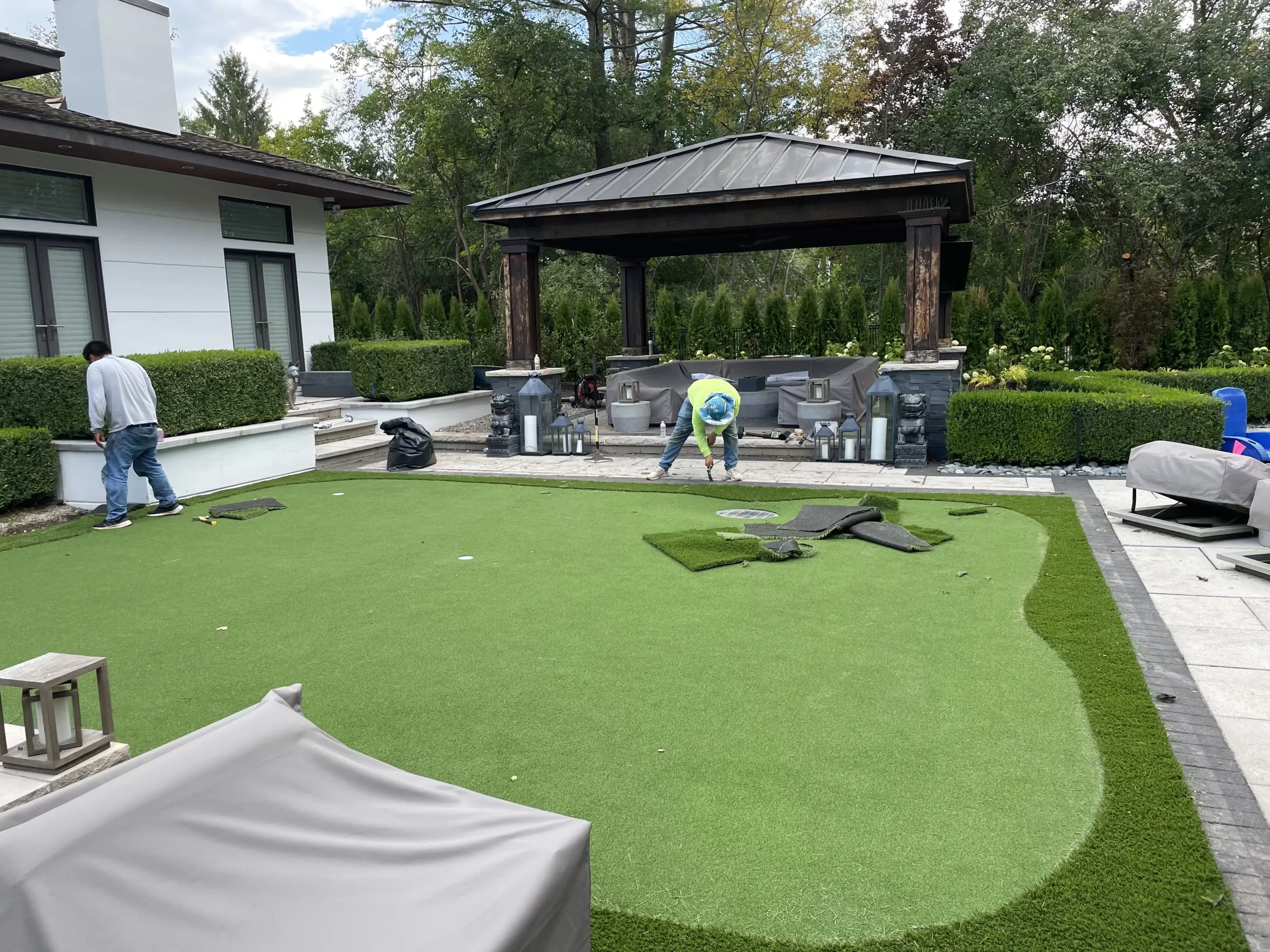
Artificial Turf of Pearland designs and installs synthetic putting greens sized for actual Pearland and south Houston backyards — not the oversized course-replica greens that consume an entire lot and require a commercial-scale budget. Most residential putting greens we install run between 200 and 600 square feet, with one to three cup positions, optional chipping zones, and green speed calibrated to a specific practice intent rather than a single standard roll.
The design conversation for a residential putting green starts with the backyard geometry, the intended use (short-game practice, chipping, or combined), the surface speed preference, and the budget. We do not have a single product we push — we specify the turf fiber, infill type, and base construction based on the homeowner's practice goals and the actual space they have available. A small Pearland backyard with one oak tree and irregular lot lines produces a different green than an open Manvel lot with 400 square feet of usable flat area.
What Is Included
A synthetic putting green installation from Artificial Turf of Pearland includes site geometry assessment, green perimeter design, base preparation with grade contours, turf placement, cup installation, infill calibration for roll speed, and closeout with a roll-speed confirmation.
The design phase is where most of the work happens. We sketch the green shape on the actual lot geometry, map the cup positions relative to the intended chipping or putting angles, and confirm the finished edge integration with existing landscaping or hardscape before any material is ordered. Homeowners see the design on paper before we commit to material.
Base preparation for a putting green is more detailed than for a standard turf installation because grade contours need to be precise for accurate ball roll. We do not build a flat base and cover it with turf — we shape the base to produce the breaks and speed the homeowner wants to practice against.
Process Steps
Step 1
We assess the available space, discuss use intent (short game only, chipping zone, or combined), confirm the surface speed preference, and sketch the green shape on the actual lot geometry.
Step 2
The green design is reviewed with the homeowner before material is ordered. Turf fiber specification, infill type, and cup positions are confirmed at this stage.
Step 3
Base preparation shapes the grade contours that produce the intended ball-roll breaks. This phase is more time-consuming than standard turf base work because contour accuracy matters for putting surface function.
Step 4
Putting surface turf is laid over the contoured base and trimmed to the designed perimeter. Cup sleeves are set at the planned positions to the correct depth for standard flagstick height.
Step 5
Infill is distributed to achieve the target roll speed discussed during the design phase. A roll-speed confirmation pass is done at closeout so the homeowner knows what to expect before the first practice session.
Use Cases
Residential putting greens in the Pearland market are most commonly installed for households where a regular golf course schedule is impractical due to commute distance, work schedule, or family obligations. The backyard green turns available time — even 20-minute windows before or after the workday — into productive short-game practice.
Households with one adult working long Texas Medical Center hours who plays golf occasionally but cannot maintain a regular course schedule. A compact backyard green makes any available window productive.
East-side Pearland backyards with partial shade from mature oaks can be designed around the shaded areas to create a green that uses the available sunlit space efficiently.
Properties with larger flat backyard areas that can accommodate a full short-game green with multiple cup positions and a separate chipping zone.
Restaurant, hospitality, or private club properties that want a backyard or patio putting surface as an amenity feature for guests or members.
Why Choose
Putting green installation quality depends almost entirely on base preparation — specifically on whether the grade contours are shaped correctly before turf is placed. A poorly contoured base produces a surface that looks like a golf green but rolls like a slow flat parking lot, regardless of how expensive the turf product is.
Artificial Turf of Pearland builds putting green contours by hand using a target-speed design rather than a cosmetic-green approach. We discuss what ball-roll speed and break character the homeowner wants to practice against, build the base to produce that behavior, and confirm it at closeout with a roll-speed check before the homeowner hits the first putt.
The scale and budget of most Pearland residential putting greens — 200 to 600 square feet — is an advantage for us. These are projects where the design conversation, the base contouring, and the closeout confirmation can all happen with the same crew member who scoped the job. There is no hand-off between a design team and an installation crew that loses information about what the homeowner actually wanted.
Pricing Factors
Putting green pricing is determined after the site visit and design conversation. We do not price a putting green from a square footage number alone because contour complexity, cup count, and soil preparation requirements vary significantly between sites. Most residential Pearland putting greens in the 200 to 400 square foot range fall within a predictable cost band that we discuss at the design conversation.
Service Area Coverage
Synthetic Putting Green Design and Install is available across Pearland and surrounding communities. Residential greens are installed across the east-side Pearland tracts, Friendswood, Manvel, Alvin, League City, Webster, and the south Houston corridor. Commercial greens are installed throughout the broader service area.
Related Services
Frequently Asked Questions
Most old Pearland east-side backyards can accommodate a 200 to 400 square foot green with one to two cup positions. We assess the available space during the site visit and design around the actual geometry, including any canopy trees.
Yes. Chipping zones are a separate turf section with a higher pile and different infill specification than the putting surface. They are designed as part of the overall green layout during the design conversation.
Green speed on a synthetic surface is controlled primarily by infill depth — more infill slows the surface; less infill speeds it up. We calibrate infill to a target speed during installation and confirm it with a roll check at closeout.
Yes. We design the green perimeter around available sunlit space. Synthetic putting turf does not require sunlight to maintain consistent surface quality — we design the green to use the actual available geometry.
Cup sleeves are set to the correct depth during base preparation, before turf is placed. We confirm cup depth at closeout so flagstick height is standard. Clay soil around the cup sleeve is compacted to prevent settling.
Final CTA
Submit the form with service type, property address, and timeline details. You can also call directly for scheduling support.
Call